A few months ago we had a visitor to our Skipton Stitchers. It was a lady called Sue asking for our help, her mother had died and when clearing her house they found two unfinished hardanger tray mats, could anyone finish them? I was called over to have a look together with another member, I was quite touched that they thought of me but it was also a big responsibility to finish a piece of such sentimental value. At first glance they basically just needed hemming, or edging in some way. I took one and the other member took the other. I did warn Sue it would be several months before I even looked at it as this was before my big European holiday.
I’ve done a little hardanger work, but it is really just a dabble, usually when a kit had a small part of hardanger such as the Strawberry Sampler book. I’ve never done a big piece of hardanger so I am by no means an expert.
When I returned from my holiday I looked into different ways of finishing a piece of hardanger. After googling various stitches I gradually realised it wasn’t meant to be hemmed, the stitched edge was the edge of the cloth, it just needed trimming. I messaged Sue to see if she had any other examples of tray cloths her mother had stitched, she sent me some photos of absolutely beautiful tray cloths, they confirmed my thought that these were meant to have a cut edge.
It was a while before I plucked up the courage to cut round the stitching. The tray cloth is edged with closely stitched buttonhole, so I had to cut right next to the stitching without catching the actual thread. I found my sharpest embroidery scissors and using my thumbnail to push the stitches out of the way.
It was fiddly and took ages but it was finally finished and I handed it over. Sue was delighted with it. When I spoke to the other member…I ended up with the second one to trim as well. This time I thought I’d take some photos in case it helps anyone else with a similar task.
I cut the bulk of the fabric off first to make it easier to handle. As I mentioned before, I used my sharpest embroidery scissors. You need a pair that’s got small blades but that are sharp to the tip, as it is the tip that is most important.
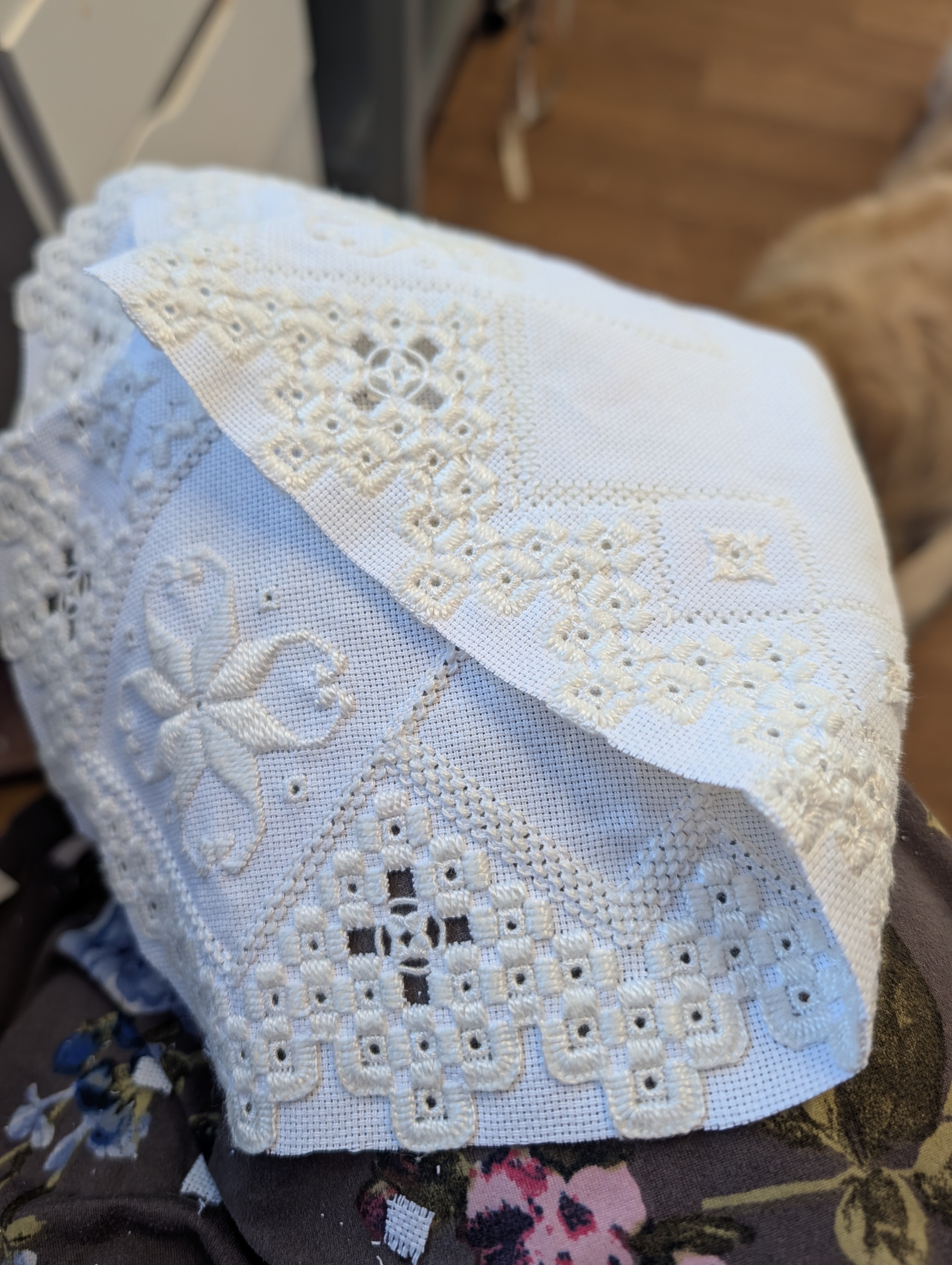
I found it easier this time to cut from the back, that was you can see clearly the threads that need cutting. This was stitched on a fine aida and I also found from the back I could see the grey of the blade though the holes so I knew I wasn’t catching the buttonhole stitch which partially covers the threads from the front. The sharp scissors meant I could easily and precisely cut into the corners.
It took a while, but here’s the finished tray cloth…
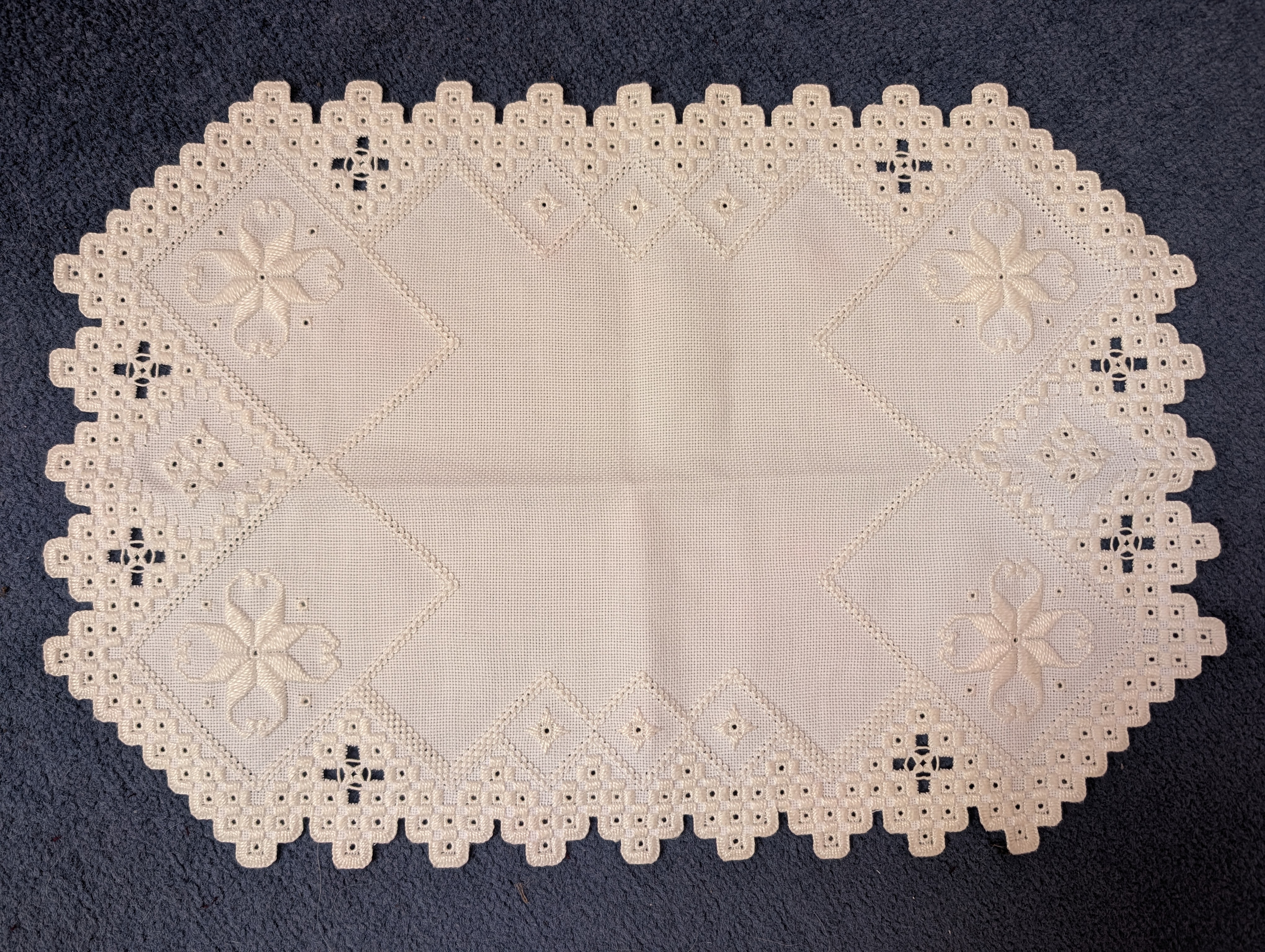
I’m pretty sure the central area was originally meant to be covered in embroidery, but I certainly wasn’t going to start trying to do that. Sue has a usable cloth of her mum’s beautiful work.


You have done a lovely job finishing these cloths. Sue’s mother was an expert Hardanger embroiderer, and you have done her proud. That edge requires concentration — one wrong snip… and I’ve done a few in that style, being a real lover of the technique. I suspect the fabric is 22ct Aida, known as “hardanger”, although original hardanger wasn’t stitched on it (just ask Yvette Stanton). The centre of the cloth is exactly as it should be. Imagine a bowl of flowers sitting in the centre of this lovely cloth. Perfect.
LikeLiked by 1 person
Thank you, it is stitched on aida, I didn’t know it was also called hardanger, the little bit of hardanger embroidery I’ve done has been on linen.
LikeLike
Wow that looks very complicated and how wonderful that you were willing to take on that project! Lovely work 🙂
LikeLiked by 1 person
Thanks Tierney 🙂
LikeLiked by 1 person
Glad we asked you Margaret, I wouldn’t have liked to tackle it! Looks great.
LikeLiked by 1 person
Thanks Sally, I was a bit happier once I worked out how it was meant to be finished!
LikeLike
Thank you for the hardanger lesson 😊 it turned out beautifully, great job!
LikeLiked by 1 person
Thank you 🙂
LikeLiked by 1 person
Really beautiful!
LikeLiked by 1 person
Thanks, the lady did some beautiful work.
LikeLiked by 1 person
Amazing, you have finished it beautifully
LikeLiked by 1 person
Thanks Jane, it’s scary cutting someone else’s work!
LikeLike
Cutting those edges can be a challenge, but you managed it beautifully Margaret!
LikeLiked by 1 person
Thanks Kathy, it was a bit nerve-wracking
LikeLiked by 1 person
I have done a lot of Hardanger in my time and yes getting really sharp scissors is a must. As for the center of the cloth, many actual tray cloths are plain after all you would not wish a cup or jug to tip on raised stitching and a pretty tea set would more likely to be set off on a plain cloth whilst the edge would frame it. No matter how many edges I have cut it is still a bit of a heart in the mouth job as there is so much work in this sort of work. Well done.
LikeLiked by 1 person
Hi, it looks great with a plain centre and the fact that there were two identical ones they probably are meant to be plain, I was just going by the photos of other tray cloths she has stitched.
LikeLiked by 1 person
You are BRAVE! The cloths turned out beautifully. Such family treasures!
LikeLike