It’s three weeks since I shared my phenology wheel. This is a challenge piece from Skipton Stitchers, my stitching group. We can stitch what we like in each month, abstract or pictorial, I’m stitching flowers from my garden and the back lane. Three weeks ago I had just caught up after my long holiday…
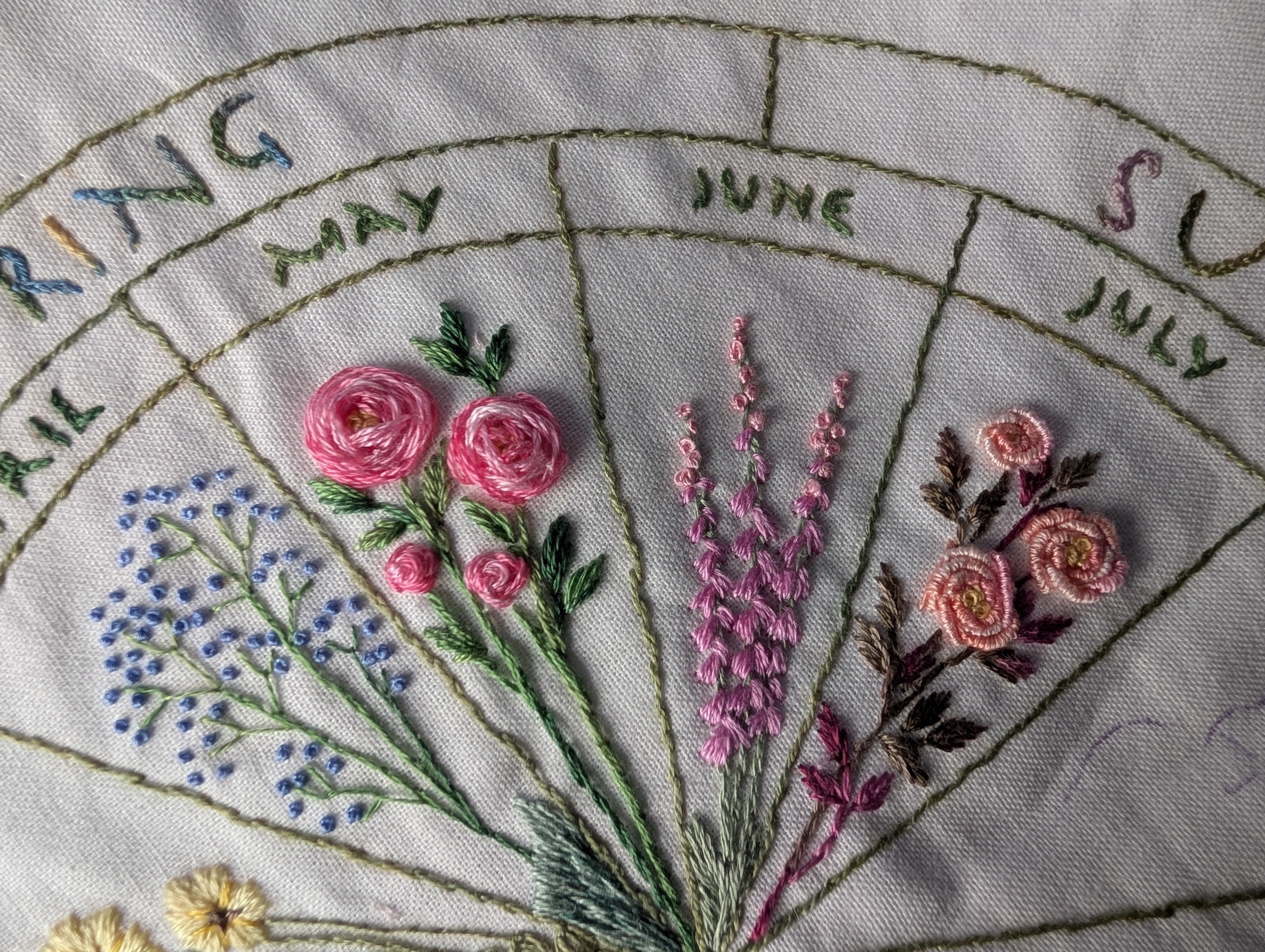
I decided to embroider clematis for August. I have a lovely purple clematis which used to grow over the arch by the patio, since changing the arch it seems to prefer the standard rose next to it! I think it’s called Ville de Lyon, though when I google it the photos all show six petalled flowers, mine seem to vary a lot, with anything from four to six petals, this year they seem to be mainly fours so I’ve embroidered the flowers with four petals!

I used stem stitch for the main stem, fishbone stitch for the leaves and satin stitch for the petals. The tendrils and the leaf stems are in split stitch and back stitch.
Next month I’m going to stitch echinacea, more commonly called the cone flower.
This stitch-a-long is organised by Avis, we all share our progress every three weeks, please follow the links to see what everyone else has been stitching.
Avis, Claire, Kathy, Margaret,
Sunny, Megan, Deborah, Daisy, Cathie,
Linda, MaryMargaret, Cindy, Helen


Your embroidery is beautiful. That clematis is very easy to identify.
LikeLiked by 2 people
Thanks Cathie, I planted it about 20 years ago but I think somewhere it still has a label on 🙂
LikeLiked by 1 person
I Google circled the embroidery flower. I asked Google what is this flower, here is what Google’s AI had to say on the matter:
The stitched design resembles Dame’s Rocket (Hesperis matronalis), a common wildflower frequently depicted in botanical embroidery patterns.
Key Identifying Features:Four distinct petals: True to the mustard (Brassicaceae) family, each blossom features exactly four symmetrical petals arranged in a cross-like formation.
Loose, creeping clusters: The blossoms climb up a winding central stem mixed with narrow, serrated green leaves.
Curly tendrils: The vine features delicate loops at the top, a stylistic choice common in wild floral embroidery patterns to give the piece a natural, whimsical movement.While it shares color characteristics with other creeping purple flora like Violets or Clematis, the distinct four-petal shape and growth structure strongly align with a Dame’s Rocket or a stylized wild phlox motif.
LikeLiked by 1 person
Well it’s definitely a clematis 😀
LikeLike
I love Clementis, our neighbor has a purple one just like yours!
LikeLiked by 1 person
When we moved into our house we had a climbing plant just like that. After a little renovation it “disappeared”, but has since come back with a vengeance. Pretty, but we didn’t really know what it was. So THAT’s what it is!
LikeLiked by 1 person
such colour and texture
LikeLike
Wow that is looking amazing 🙂
LikeLike
beautiful! Love the august addition
LikeLike